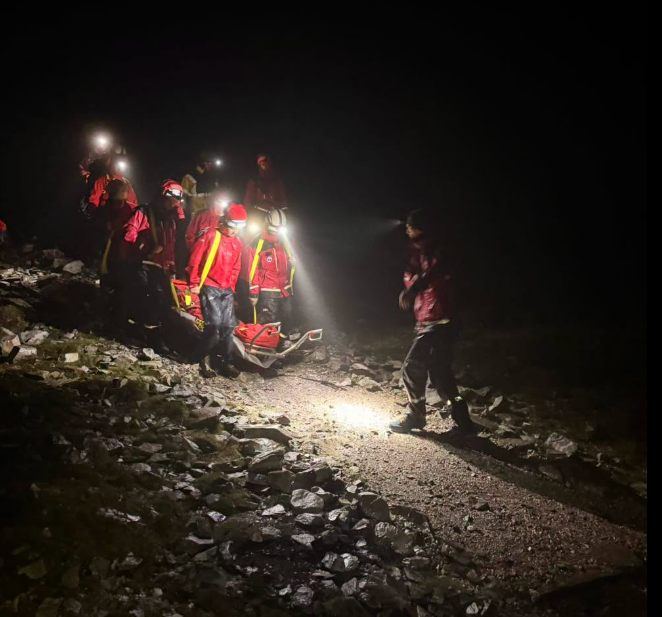
Donegal Mountain rescue Team has released details of a major overnight rescue on Errigal on Friday night and into yesterday morning.
At approximately 20:17 on Friday, DMRT was tasked by the National Ambulance Service to assist a person who had slipped and sustained a lower leg injury.The casualty was located and stabilised, and then stretchered down the mountain to a waiting ambulance in the car park
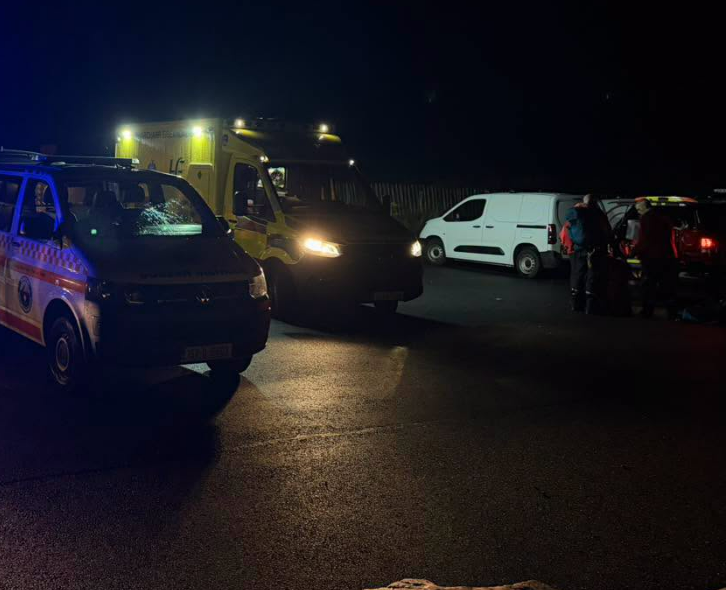
The ambulance left the car park at 01:06, almost five hours after the call out began.
DMRT say this incident is a reminder that mountain conditions can change very quickly at this time of year.
********************
Full account from DMRT –
At approximately 20:17, Donegal Mountain Rescue was tasked by the National Ambulance Service to assist a person who had slipped and sustained a lower leg injury on Errigal. A call out was issued to team members through SARCALL. One of the team’s call out coordinators, working remotely, used the phone find system to identify the casualty’s location and provide a digital map reference, giving responders vital information before deployment. A second coordinator contacted the casualty directly to gather further details regarding their condition and injuries, while team members made their way to the rendezvous point at Errigal Car Park.
On arrival, a Critical Care Doctor was already present. As 16 team members assembled, a hasty team was deployed ahead to stabilise the casualty and provide additional clothing and first aid. By this stage, darkness had fallen, weather conditions were deteriorating, and visibility on the mountain was poor. Malin Head Coast Guard (MRCC) advised that Rescue 118 helicopter had also been tasked and was inbound to the location.
Communication was established with Rescue 118 while the hasty team continued towards the casualty. The helicopter crew confirmed that the casualty was located at approximately 550 metres. However, despite several attempts, worsening weather conditions prevented the crew from safely lowering a winchman to the casualty, and Rescue 118 was unfortunately required to return to base in Sligo.
Meanwhile, two members of the casualty’s group made their way to the car park, where they were assessed by the Critical Care Doctor in the ambulance that had been dispatched by the National Ambulance Service. Additional team members, accompanied by a National Ambulance Service paramedic, were deployed with full rescue equipment, including a stretcher, vacuum mattress, and thermal casualty wrap. Conditions at this point included total darkness, rain, low cloud cover, and significantly reduced visibility.
The hasty team located the casualty, administered first aid, and placed the person in a shelter to begin warming them. Shortly afterwards, the stretcher team arrived. Due to the worsening conditions, a team member escorted the remaining three members of the casualty’s group safely down to the car park, where they were placed in the ambulance to be checked over and warmed.
On the mountain, the casualty was stabilised, secured in a full-body vacuum mattress, wrapped in a thermal casualty wrap, and placed in the stretcher for the long carry down to the car park. The team worked in wet, cold conditions with visibility reduced to approximately five metres in cloud.
The call-out began at 20:17, and the ambulance left the car park at 01:06, 4 hours and 49 minutes later. This incident is a reminder that mountain conditions can change very quickly at this time of year. A minor mistake can turn a pleasant day hike into a serious emergency. Please be prepared: bring extra clothing, carry a head torch, ensure your phone battery is charged, and turn back if conditions deteriorate.
We wish the casualty well and a speedy recovery.
Donegal Mountain Rescue would like to acknowledge all those involved in this multi-agency overnight operation, including Malin Head Coast Guard, Rescue 118, the National Ambulance Service, the Critical Care Doctor, the ambulance crew, and the Donegal Mountain Rescue team members involved. Please take care when heading into the mountains and remember that weather conditions can be very different at higher levels.