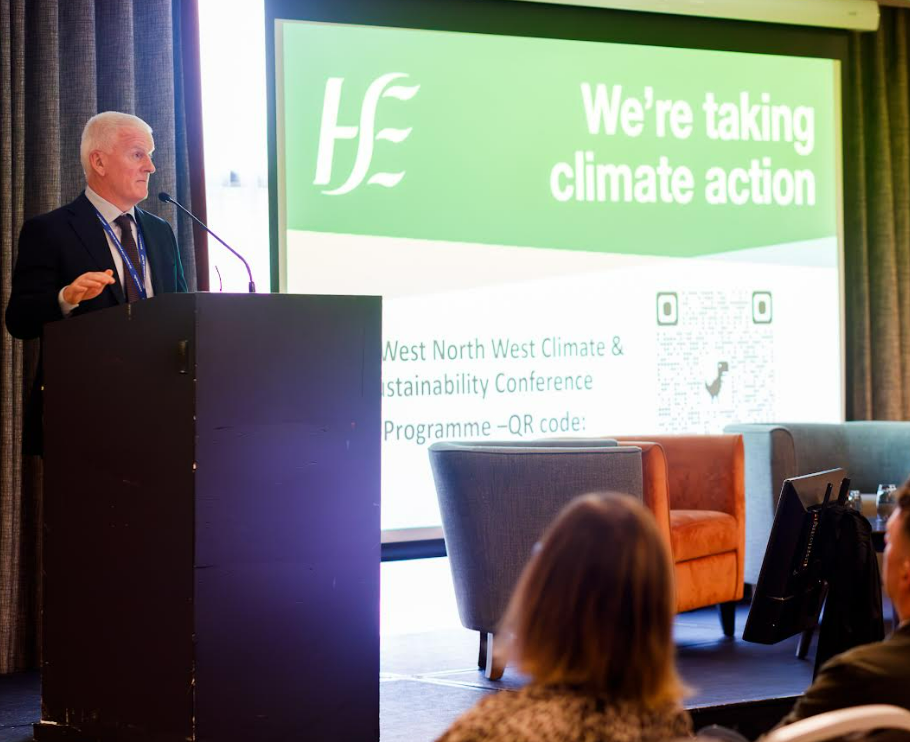
The impact of healthcare on the climate has been explored at a HSE West and North West conference on climate and sustainability.
The event in Sligo looked at ways of achieving improvements, with proposals such as turning clinical waste into reusable needle bins, auditing inhaler use to reduce CO2 emissions, and turning Emergency Departments Green considered by over 350 delegates and speakers.
The HSE’s Regional Executive Officer Tony Canavan told the event that climate change is a health issue and it’s important that the HSE makes that connection. He said it’s gratifying that this region is showing leadership in this regard.
The organisation is working on a Regional Green Plan which will outline a structured approach to reducing Greenhouse Gas emissions, along with planned actions over the next three years up to 2026 to deliver immediate reductions in some areas, while building long-term capabilities in others.
The HSE’s Green Plan was also highlighted.
It aims to deliver measurable carbon reduction, improve resilience, and embed sustainability into regional healthcare.
The conference was told there are numerous initiatives being implemented right across the HSE, including a programme to reduce the carbon footprint of inhalers.
Overall, the HSE aims to reduce Greenhouse Gas emissions by 51% by 2030, and achieve net zero by 2050.
***********************
HSE release in full –
Media Release
How healthcare can positively impact climate and sustainability – focus of HSE West and North West Conference
16 March 2026
The impact of healthcare on our climate and how to make improvements formed the basis of the HSE West and North West climate and sustainability conference in Sligo recently.
Initiatives such as turning clinical waste into reusable needle bins, auditing inhaler use to reduce CO2 emissions and turning Emergency Departments Green were just some of the topics touched on by the speakers.
Over 350 people attended the conference in person and remotely on the day.
As one of the biggest employers in the region, the responsibility of HSE to play it’s role in climate protection and promoting sustainability was the pivotal message of the day.
Tony Canavan, REO HSE West and North West said “Climate change is a health issue and it’s important that the HSE makes that connection. I’d like to thank the people who will pick up the baton and carry it and pass it on within our health services. I’m pleased that this region is showing leadership in relation to climate change and by showing leadership we are encouraging others to join us.”
John Fitzmaurice, HSE Integrated Healthcare Area Manager, Sligo. Leitrim, South Donegal, West Cavan said “We all need to ask ourselves the question, is there one thing I can do? Simple interventions can have big results. We are working on our Regional Green Plan which will outline a structured approach to reducing our Greenhouse Gas (GHG) emissions, along with our planned actions over the next three years (covering the 2026 to 2029 period). This three-year horizon is designed to strike a balance between delivering immediate reductions in some areas while building long-term capabilities in others.”
Public Health Specialist working with Trinity College Dublin and the HSE, Dr. Teresa O’Dowd, discussed how reducing the carbon footprint of inhaler prescribing is an important step in tackling healthcare’s contribution to climate change. Educational interventions were used to switch patients from high carbon to low carbon inhalers resulting in estimated carbon saving of 21,448kg of CO2
Professor Francis Finnucane, Consultant Endocrinologist at Galway University Hospitals, discussed the obesity crises and environmental links. He said that the change in our food environment has changed eating patterns and the use of pesticides are damaging our environment. A solution to some of these issues, he recommended, is the adoption of a plant-based diet, the improvement public transport and the development of more greenways.
Programme Manager for the HSE Climate Action and Sustainability Programme, Roisin Breen, discussed the HSE’s Green Plan which aims to deliver measurable carbon reduction, improve resilience, and embed sustainability into regional healthcare while her colleague Niall Walsh, Project Manager with the HSE Climate and Sustainability Programme said the focus of 2026 was the establishment of national forums to keep the climate conversation going.
Dr Niall McCormick, Core Speciality Trainee in Emergency Medicine, spoke about ED’s at GUH and MUH receiving Bronze accreditation for Green ED’s from the Royal College of Emergency Medicine. Some of their changes mean they now use 100% recycled paper, climate health communications provided to staff and patients, waste streams are reviewed and initiatives to improve segregation have started. He also discussed how on-site energy consumption has been reduced and they have eliminated unnecessary canulation.
Fiona Dowling, Commercial Director with Stericycle, described how they supply reusable sharps containers across 65 public and private hospitals in Ireland. These reusable containers, which themselves are made from recycled waste can be reused 600 times after washing and decontamination.
Ailbhe Healy, Water Stewardship Advisor discussed the Water Stewardship Programme which promotes the use of water as it is socially and culturally equitable, environmentally sustainable and economically beneficial. This she said is achieved through a stakeholder-inclusive process that includes both site and catchment-based actions.
Declan McGoldrick, HSE Capital and Estates Energy Manager, outlined the HSE’s Deep Retrofit Programme to refurbish and upgrade HSE accommodation.
Finally Dr Annmarie Crosse, Sláintecare Healthy Communities Coordinator, discussed placing communities at the centre of integrated climate and health action in Donegal. She outlined the importance of nature and health connections as ecological determinants within local healthy community plans.
The Government’s Climate Action Plan sets binding targets for energy efficiency and greenhouse gas (GHG) reduction across the public sector. In response, the HSE has developed an Infrastructure Decarbonisation Roadmap (revised in 2024), setting out progress to date and the pathway to meeting these targets. Key commitments include reducing energy-related GHG emissions by 51% by 2030 and achieving net zero by 2050, improving HSE energy efficiency by 50% by 2030 and ending the installation of fossil fuel heating systems in new builds and major retrofits after 2023, except in exceptional circumstances.