Met Éireann has released its latest monthly climate report, showing last month was the second hottest July since 1900.
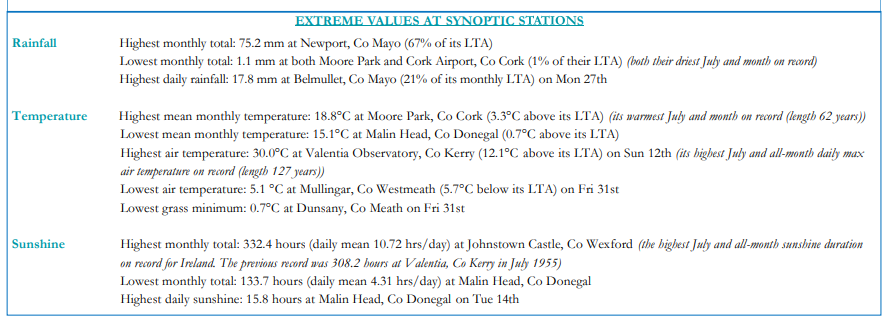
However, the weather station at Malin Head in Donegal recorded the lowest mean temperatures for the month, and also the lowest daily average sunshine figures.
July was one of the sunniest months on record for Ireland, with a daily mean of 10.72 hours of sunshine.
However, the lowest mean figure, recorded at Malin Head in Donegal, was 4.31 hours per day.
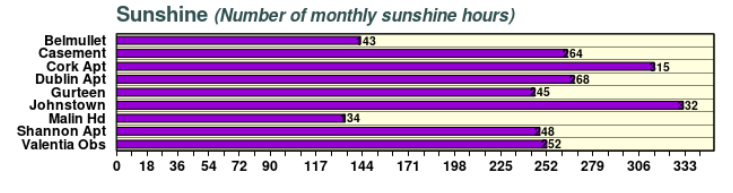
Conversely, the highest amount of sunshine recorded at a weather station in one day was 15.8 hours, recorded at Malin Head on Tue the 14th.
The national mean temperature for the month was 17.25 degrees celsius, which has only ever been topped by the mean temperature for July 2013 of 17.34 degrees.
The lowest temperature for the month at a single station was 15.1 degrees, again recorded at Malin Head.
National statement in full –

Exceptionally warm, dry and sunny
July 2026 was dominated by high pressure, which resulted in one of the hottest, driest and sunniest months on record for Ireland. Atlantic weather fronts were kept away to
the north and west for most of the month. Any fronts that did encroach brought some cloud and rain, mostly to the North and West, but it stayed predominantly dry elsewhere. This setup resulted in a lot of sunshine, especially for the South and East, along with consistently high temperatures. The first week saw high pressure to the south
steering a warm and moist westerly airflow across the country with some imbedded weak weather fronts. This brought light rain and drizzle at times, especially to the West and
North, but as the week progressed it got drier, warmer and sunnier. During the second week high pressure built over and then to the north of Ireland. It stayed mostly dry and
very warm or hot in most places. It also became sunnier in the West as the airflow became easterly. The third week saw the high pressure move to the west of Ireland changing
the airflow to a more northerly direction. It stayed mostly dry but cooled down a bit over the northern half of the country with more cloud for the Northwest. During the
fourth week the high pressure pulled away to the southwest allowing an Atlantic westerly airflow to take hold. This brought more cloud overall and some frontal rain or showers at times, mostly to the West and North, but the South and East stayed generally dry. The month finished slightly cooler and mostly dry with high pressure to the west.
Rainfall: Exceptionally dry, driest month on record for parts of the South
All monthly rainfall totals across the country were below their 1991-2020 Long-Term Average (LTA). Percentage of monthly rainfall values ranged from 1% at both Cork
Airport, Co Cork (1.1 mm) and Moore Park, Co Cork (1.1 mm) (both their driest July and month on record (record length 64 and 62 years respectively)) to 72% (61.5 mm) at Malin Head,
Co Donegal. Monthly rainfall totals ranged from 1.1 mm at both Cork Airport and Moore Park, Co Cork to 75.2 mm (67% of its LTA) at Newport, Co Mayo. The highest
daily rainfall total was 17.8 mm at Belmullet, Co Mayo on Monday 27th. The number of rain days0 ranged from 1 day at Johnstown Castle, Co Wexford to 17 days at Malin
Head, Co Donegal. The number of wet days1 ranged from zero days at a few stations to 11 days at Newport, Co Mayo. The number of very wet days3 ranged from zero days at
most stations to 3 days at Newport, Co Mayo. Climatological dry periods occurred at all stations during July. All 25 stations saw dry spells6 between Wednesday July 1st and
Sunday August 2nd lasting between 19 and 33 days. Of those, 20 stations mostly in the Midlands, South and East also saw absolute droughts4 between Wednesday 1st July and
Tuesday 28th July lasting between 15 and 27 days. Of those, 15 stations in the Midlands, South and East also saw partial droughts between Saturday 20th June and Monday 3rd
August lasting between 27 and 45 days (with three stations in the East and Southeast still ongoing up to 3rd August). 17 stations had their driest July on record. Of those, 4 stations in the
South, Cork Airport (1.1 mm), Moore Park (1.1 mm), Oak Park, Co Carlow (1.5 mm) and Johnstown Castle, Co Wexford (1.5 mm), had their driest month on record (record
lengths between 21 and 85 years).
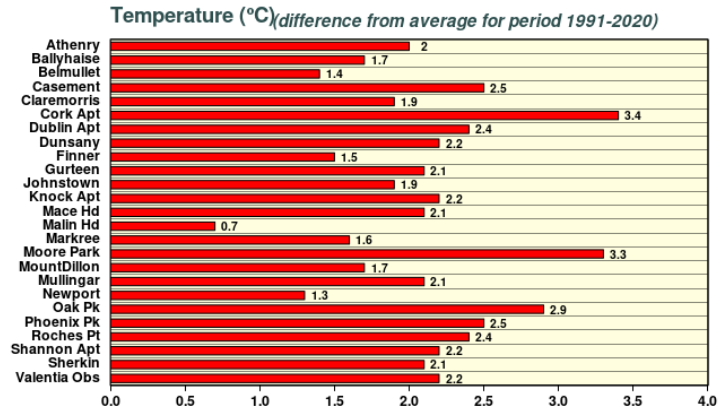
Temperature: Significantly above average everywhere, record high in parts of the South and East
All mean air temperatures across the country were above their LTA for the month. Deviations from mean air temperature ranged from +0.7 °C (15.1 °C ,the month’s lowest
mean temperature) at Malin Head, Co Donegal to +3.4 °C (18.5 °C) at Cork Airport, Co Cork (its warmest July and month on record (length 64 years)). Mean temperatures were as
much as 18.8 °C (3.3 °C above its LTA) at Moore Park, Co Cork (its warmest July and month on record (length 62 years)). The month’s lowest temperatures were recorded on Friday
31st. The lowest air minimum of 5.1 °C was reported at Mullingar, Co Westmeath and the lowest grass minimum of 0.7 °C was reported at Dunsany, Co Meath. The highest
maximum was reported on Sunday 12th at Valentia Observatory, Co Kerry with a temperature of 30.0 °C (its highest July and all-month daily maximum air temperature on record (length
127 years)). There was no air or ground frost reported this month. Heatwaves7 were reported at 7 stations between Sunday 5th and Friday 17th lasting between 5 and 13 days.
Oak Park, Co Carlow with 12 days broke its previous longest heatwave record by one day, set in June/July 2018. Moore Park, Co Cork with 13 days broke its previous longest
heatwave record by three days, set in July 2021. Moore Park, with 13 days, had the second longest heatwave on record for Ireland, behind 14 days set in Birr, Co Offaly and
Ballybrittas, Co Laois in August 1976 (Note: the Average temperature in Birr, Co Offaly during its 14 day heatwave in 1976 was 17.9 °C, while the average temperature in Moore Park, Co Cork
during its 13 day heatwave in 2026 was 20.4 °C, a difference of 2.5 °C). 8 stations in the South and East had their warmest July on record. Of those, 4 stations, Cork Airport (18.5 °C
mean temp), Moore Park (18.8 °C), Phoenix Park, Co Dublin (18.2 °C) and Casement, Co Dublin (18.0 °C) had their warmest month on record (record lengths between 62 and 127
years). Phoenix Park, Co Dublin reported 36 consecutive days with maximum daily temperatures above 20 °C between June 30th and August 3rd (still ongoing). This surpasses
the previous record at a synoptic station of 34 days at Shannon Airport set in July/August 1995 and surpasses its own record of 27 days set in July 1989.
Sunshine: Record breaking sunshine in the South and East
All available sunshine totals were above their LTA. Percentage of monthly sunshine values ranged from 172% (264.0 hours) at Casement Aerodrome, Co Dublin (its sunniest
July on record (length 62 years)) to 183% (247.7 hours) at Shannon Airport, Co Clare (its sunniest July since 1955). Monthly sunshine totals ranged from 133.7 hours (no LTA comparison*) at Malin Head, Co Donegal to 332.4 hours (no LTA comparison*) at Johnstown Castle, Co Wexford (the highest July and all-month sunshine duration on record for Ireland. The
previous record was 308.2 hours at Valentia, Co Kerry in July 1955). Cork Airport, Co Cork also had its sunniest month on record and surpassed the previous all-month sunshine
duration record with 315.1 hours (No LTA comparison*).
Wind: Gales reported at one station
Monthly mean wind speeds ranged from 5.2 knots (9.6 km/h) at Ballyhaise, Co Cavan to 13.0 knots (24.1 km/h) at Malin Head, Co Donegal. Gales were reported on Wednesday 1st at Malin Head, Co Donegal. The number of days with gale force winds ranged from zero days at most stations to 1 day at Malin Head, Co Donegal. There were no
strong gales or storms reported this month. Both the month’s highest gust and 10-minute mean wind speed was reported at Malin Head, Co Donegal on Wednesday 1st. The
highest gust was 47 knots (87 km/h) while the month’s highest 10-minute mean wind speed was 36 knots (67 km/h).