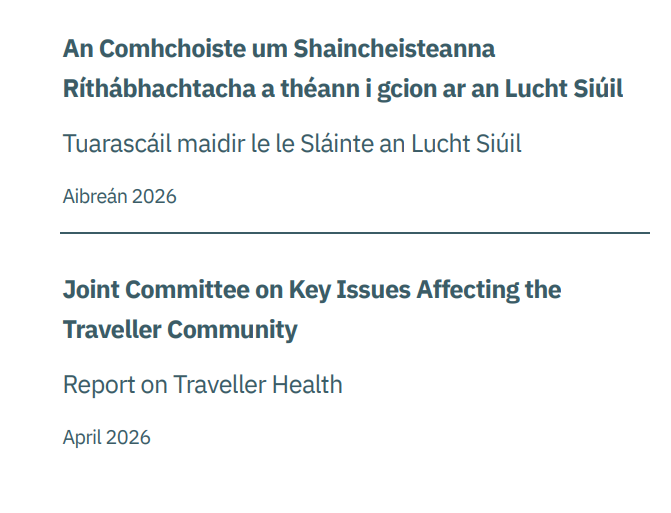
The Joint Committee on Key Issues affecting the Traveller Community today published its Report on Traveller Health, in which it makes 69 recommendations which impact on the provision and delivery of health and mental health services to Travellers across the country.
Committee Cathaoirleach Deputy George Lawlor says the report does not simply outline policy failures; it exposes the human cost of those failures. The disparities in health outcomes, the disproportionate burden of mental ill health, and the lived experiences shared with the Committee all point to a crisis that can no longer be met with incremental or symbolic responses. The status quo has already inflicted too much harm.
Donegal based Senator Eileen Flynn is Leas Cathaoirleach of the committee.
She’s welcoming the report, but says many of its recommendations were included in previous reports but never acted on……..
Release in full –
Joint Committee on Key Issues affecting the Traveller Community publishes Report on Traveller Health; makes 69 recommendations impacting on health and mental healthcare
The Joint Committee on Key Issues affecting the Traveller Community today published its Report on Traveller Health, in which it makes 69 recommendations which impact on the provision and delivery of health and mental health of Travellers across the country.
Committee Cathaoirleach Deputy George Lawlor said: “I am presenting this Report on Traveller Health and Mental Health with a deep sense of responsibility and urgency. The evidence laid before the Committee is stark, unambiguous, and profoundly troubling. It reveals a pattern of racism, discrimination, and systemic neglect that has left an entire ethnic community feeling abandoned within its own country. The findings speak to a pervasive lack of hope among Travellers – an erosion of trust that has taken root after generations of unequal treatment and unmet commitments.
“This report does not simply outline policy failures; it exposes the human cost of those failures. The disparities in health outcomes, the disproportionate burden of mental ill health, and the lived experiences shared with the Committee all point to a crisis that can no longer be met with incremental or symbolic responses. The status quo has already inflicted too much harm.
“A radical change of direction from government departments, State agencies, and public services is now urgently required. Only a coordinated, sustained, and accountable shift in approach will begin to reverse the serious hardships faced by Travellers in Ireland. This must include meaningful engagement with Traveller organisations, culturally appropriate service provision, and a recognition – finally – of the dignity, identity, and rights of the Traveller community.”
In its report, the Committee makes 69 recommendations across 18 areas covering ethnic identity, culturally appropriate health services, accessibility of health care, health screening, policy approaches, Traveller primary health care projects, and service provision. Further areas covered by the recommendations also include breastfeeding, suicide, mental health, accommodation, LGBTQ+ Travellers, gender, children, staffing and recruitment, substance abuse, and employment.
Key recommendations of the Committee include:
- Introduce an ethnic identifier for Travellers across all state agencies and public services in line with the recommendation of the All Ireland Traveller Health Study, 2010;
- Ensure culturally appropriate public services by introducing anti-racism training for workers engaging with Travellers;
- Provide health services communications in ways accessible to those with low literacy levels, including via phone calls, including plain English explanations of medical terminology in letters, follow-ups by phone, text and in person by public health nurses;
- Review and lower the eligible age for CervicalCheck cervical screening for Traveller women to 20 years of age, in recognition of earlier average age of marriage within the Traveller community and the associated earlier onset of HPV exposure risk;
- Adopt an approach of progressive universalism by designing and funding systems and projects to be universally accessible with specific, targeted supports for Travellers and other minority groups;
- Support existing PHCPs with permanent funding to expand the programmes nationally across the Traveller population;
- Dedicate ringfenced funding for Traveller health and mental health rather than relying predominantly on pilot schemes, short-term funding, dormant accounts funding;
- Ensure permanent funding of Suicide Crisis Assessment Nurses (SCAN) to ensure universal access for all Travellers across the country. Grow the workforce beyond the current 16 SCAN nurses;
- Improve access to mental health services for Travellers in the justice system;
- Improve the standard of Traveller accommodation as a factor of healthcare inequality through the Department of Housing and local authorities;
- Support codesign and delivery of mental health services for LGBT Travellers in cooperation with the National Action Group for LGBTI+ Traveller & Roma Rights;
- Promote anti-racism in schools through the Department of Education to improve the treatment and wellbeing of Traveller children;
- Support the creation of more permanent projects to support Traveller women on a national level; and secure permanent funding via Cuan for domestic violence services such as those provided by Exchange House and provide them on a national scale.
- Assess and improve the compensation and working conditions for Traveller Primary Health Care Project workers (PHCP) by funding increased pay, pensions, medical cards;
- Assess the rate of overprescribing and over the counter drug abuse via disaggregated healthcare data; and provide Traveller specific addiction support services;
- Increase access to employment for Travellers to mitigate the impacts of unemployment and poverty as contributing factors to poor mental health in the Traveller community.
The Committee urges the Government to implement the recommendations of reports made by previous iterations of this Committee in the 32nd and 33rd Dáileanna, and also endorses recommendations from Beyond the Poverty Trap report by Pavee Point and Report on the Traveller and Roma Mental Health Working Group.
Deputy Lawlor said: “On behalf of the Committee, I would like to thank most sincerely those who came before us as witnesses to share their expertise, opinions, knowledge and proposals. Their input has been invaluable. The Committee hopes that this report will serve not only as a record of the challenges, but as a catalyst for the decisive action that has been lacking for far too long. The Traveller community deserves nothing less than a future defined by equality, respect, and genuine opportunity.”
The Joint Committee on Key Issues affecting the Traveller Community has 14 Members, nine from the Dáil and five from the Seanad. The Committee’s Report on Traveller Health is available on the Oireachtas website.