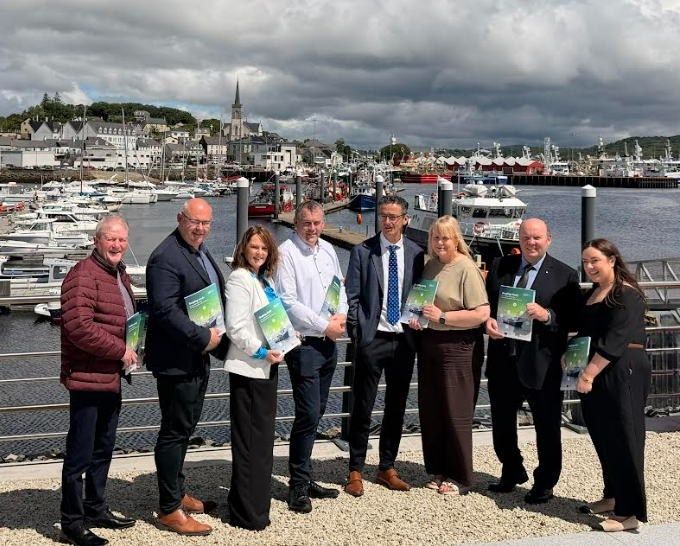
Bord Iascaigh Mhara and Donegal County Council have launched a new report assessing the potential of Ireland’s blue bioeconomy.
The blue bioeconomy is based on converting renewable selfie such as seaweed, algae, and fishery by-products into products such as pet food, pharmaceuticals and cosmetics.
The Blue Bioeconomy Scoping Report assesses industry needs, supports, and international best practice, and outlines a clear set of priority actions required to unlock growth in this emerging sector.
A key outcome is the creation of a northwest Blue Bioeconomy Steering Group to guide implementation, strengthen collaboration and ensure industry input.
BIM Innovation Manager Michael Gallagher says this marks a significant step towards aligning supports for seafood sector companies, with the aim of maximising value from marine biomass.
He says Ireland possesses a wide diversity of high-calibre marine researchers, and progress is already being driven by industry leaders in both the northwest and southwest.
The report notes that active engagement with regional networks is generating high-potential opportunities, and if those resources can be harnessed at a national level with supports across relevant state agencies, a clear and coherent pathway can be created for the seafood sector to diversify and unlock greater value from the blue bioeconomy.
Director for Economic Development for Donegal County Council, Gary Martin says they’re keen to unlock the sector’s full potential:
Photo: IMG_9237: Bord Iascaigh Mhara (BIM), Ireland’s Seafood Development Agency, in partnership with Donegal County Council, launched a new report assessing the potential of Ireland’s blue bioeconomy, included at the launch in Killybegs are Cllr Noel Jordan, Cllr Michael Boyle, Cllr Niamh Kennedy, Cllr Jimmy Brogan, Michael Gallagher, Innovation Manager, BIM, Mairead Carlin, Economic Development Officer, Donegal County Council, Garry Martin, Director of Human Resources, Economic Development and Emergency Services and Cliodhna Griffin, Business Development Executive at BIM.
********************************
Release in full –
BIM and Donegal County Council launch blue bioeconomy report to drive seafood
sector innovation
Bord Iascaigh Mhara (BIM), Ireland’s Seafood Development Agency, in partnership with
Donegal County Council, today (Friday, 19 June 2026) launched a new report assessing the
potential of Ireland’s blue bioeconomy.
The Blue Bioeconomy Scoping Report assesses industry needs, supports, and international
best practice, identifying a clear set of priority actions required to unlock growth in this
emerging sector. A key outcome is the creation of a northwest Blue Bioeconomy Steering
Group to guide implementation, strengthen collaboration and ensure industry input.
This marks a significant step towards aligning supports for seafood sector companies, with
the aim of maximising value from marine biomass.
Speaking at the launch, BIM Innovation Manager Michael Gallagher noted:
“Given the challenges the sector has faced with quota reductions, biomass shortages, and
rising supply chain costs, it is crucial that we generate more value from every fish.”
He emphasised the importance of diversification into higher-value markets, highlighting
growing interest among Irish seafood processors in pursuing opportunities in these emerging
areas.
Gallagher further highlighted Ireland’s strong research capacity, noting:
“Ireland possesses a wide diversity of high-calibre marine researchers, and progress is
already being driven by industry leaders in both the northwest and southwest. Active
engagement with regional networks is generating high-potential opportunities. If we can
harness these resources at a national level and align supports across relevant state
agencies, we can create a clear and coherent pathway for the seafood sector to diversify
and unlock greater value from the blue bioeconomy.”
At the core of the initiative is the recognition that the blue bioeconomy offers a wide range of
opportunities. In the short term, more accessible applications include converting marine co-
products and underutilised resources into biostimulants and pet food ingredients. At the
same time, there is considerable longer-term potential to develop higher-value products such
as proteins, collagen, nutraceuticals, and biomaterials.
BIM, in collaboration with Donegal County Council and the diversity of steering group
members, is well positioned to play a leading role in advancing this agenda, supporting
companies to access funding, connect with research expertise, and engage in collaborative
networks.
Supported by the European Maritime, Fisheries and Aquaculture Fund, this initiative
reinforces the northwest’s role as a hub for blue bioeconomy development, with inter-agency
collaboration identified as a foundational element in unlocking the sector’s full potential.