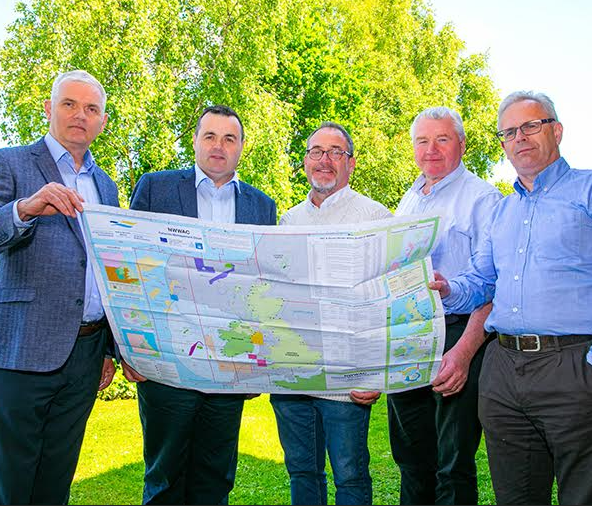
Fisheries ministers from across the European Union are in Cork for two days of meetings, led by Agriculture and Fisheries Minister Martin Heydon, on the theme of ‘generational renewal’.
The industry says discussions are important, but the Seafood Ireland Alliance says at a time when fishers are faced with a chronic shortage of quota and spiralling operational costs, survival — not generational renewal — should be the priority.
Donegal TD and SF Marine Spokesperson Padraig MacLochlain has again criticised the fact that Fisheries Minister Timmy Dooley is not leading the meetings.
Aodh O’Donnell of the SIA says what’s needed is a whole of government approach, with all levels of government fighting for the industry……
EU Ministers fiddle while the Irish fishing industry burns
Cork, 28 July 2026 — As EU Fisheries Ministers gather in Cork under Ireland's Presidency
to discuss generational renewal in Fisheries and Aquaculture, fishermen around the ports of
Ireland are pondering their futures. Faced with a chronic shortage of quota and spiralling
operational costs, survival — not generational renewal — is the mantra of the industry here.
The Seafood Ireland Alliance (SIA) acknowledges the importance of bringing EU Fisheries
Ministers to Cork to showcase the potential of the Irish seafood sector. However, the
Government must use this moment to highlight how the Common Fisheries Policy (CFP) has
failed the Irish industry and decimated the fish stocks around our island nation —
jeopardising any future for the next generation of fishermen.
Patrick Murphy of the Irish South and West Fish Producers' Organisation said: "The crisis in
the industry is deepening. Long-established family businesses built through generations are
going to the wall with the lack of fish available to catch and process. To halt this decline, to
protect what little we have left, we need the support measures promised by the Taoiseach to
the sector last December to materialise quickly."
The SIA points out that the challenges facing the industry are unprecedented. The losses in
quotas for 2026 are estimated at over €200 million for the sector. Such losses challenge the
economic viability of the entire sector, starve fish processing businesses of raw material, and
impact the service industries that support coastal communities.
Aodh O’Donnell of the Irish Fish Producers’ Organisation said: "No industry would be able to
withstand the scale of losses we are experiencing without help. The quota cuts borne by our
members are approximately 33% in one year. This dire situation, combined with long-
standing imbalances in shared stocks, is now threatening the viability of fleets, processors
and the communities that depend on them.
John Lynch of the Irish South and East Fish Producers’Organisation commented on the toll
the decline is taking on coastal communities: Up and down the coast, from Greencastle to
Castletownbere, fishing is no longer the backbone of coastal communities. Once-thriving
fishing ports are now hubs for passengers from cruise liners, dining in fish restaurants selling
imported fish from anywhere but Ireland."
Brendan Byrne, commenting in relation to the Irish fish processing sector, cautioned: “The
failures of Common Fishery Policy are self-evident. Ireland with over 12% of EU Waters is
struggling to survive; our entire fishing sector is undermined by a combination of the failures
of the CFP and successive EU Commissions failing to defend the interests of Member State
Ireland. The Common Fisheries Policy has really become the Colonial Fisheries Policy.”
Coming on the back of the recently issued Mulvey Report that highlighted many of the
challenges facing the industry, there is guarded optimism that the Seafood Vision Report, to
be published shortly, will map out a way forward.
Dominic Rihan of the Killybegs Fishermen’s Organisation concluded: We are committed to
developing robust and sustainable stock rebuilding plans. This will require a reduction of
effort by other EU fleets to allow key stocks replenish. While our future is uncertain, we are
not without hope — but this is predicated on the Government honouring the commitments
made to us. This turnaround will require the effective implementation of a comprehensive
suite of measures and supports built on sustainability. This is a prerequisite to underpin a
robust long-term vision for the future."